
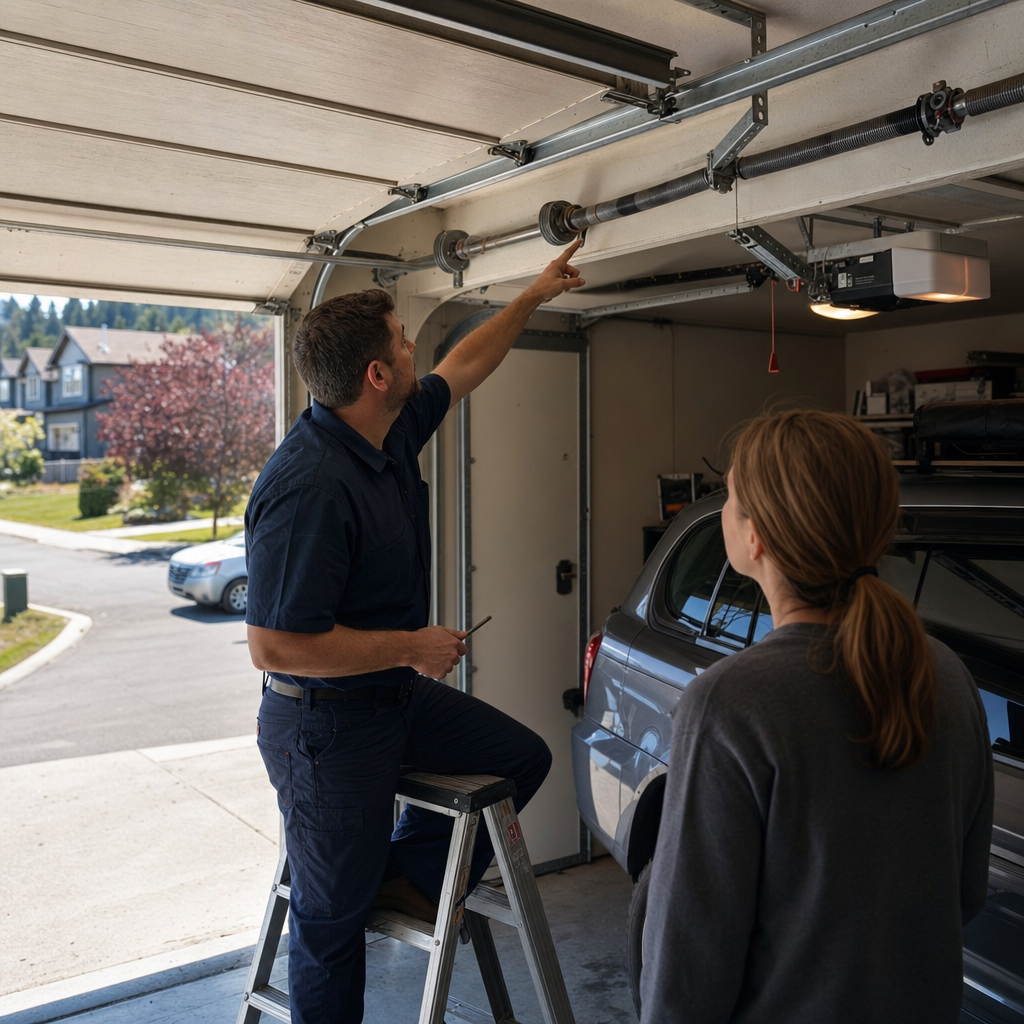
Why Does My Garage Door Reverse Before Hitting the Floor in Spokane?
A garage door that reverses before closing fully is almost always triggered by the opener’s safety system detecting unexpected resistance — most commonly misaligned photo-eye sensors, but in Spokane’s freeze-thaw climate, the culprit is often your concrete apron heaving or your bottom seal frozen to the slab. The opener’s down-limit mechanism measures motor resistance at the close position; when the door meets an obstacle — including a slab that’s risen a quarter-inch since summer — it reverses as designed. If your sensors show steady lights but the door still won’t stay down, you’re likely dealing with a mechanical or calibration issue, not a sensor problem. Call us at (844) 656-2094 if you’d rather have Thomas diagnose it in person.
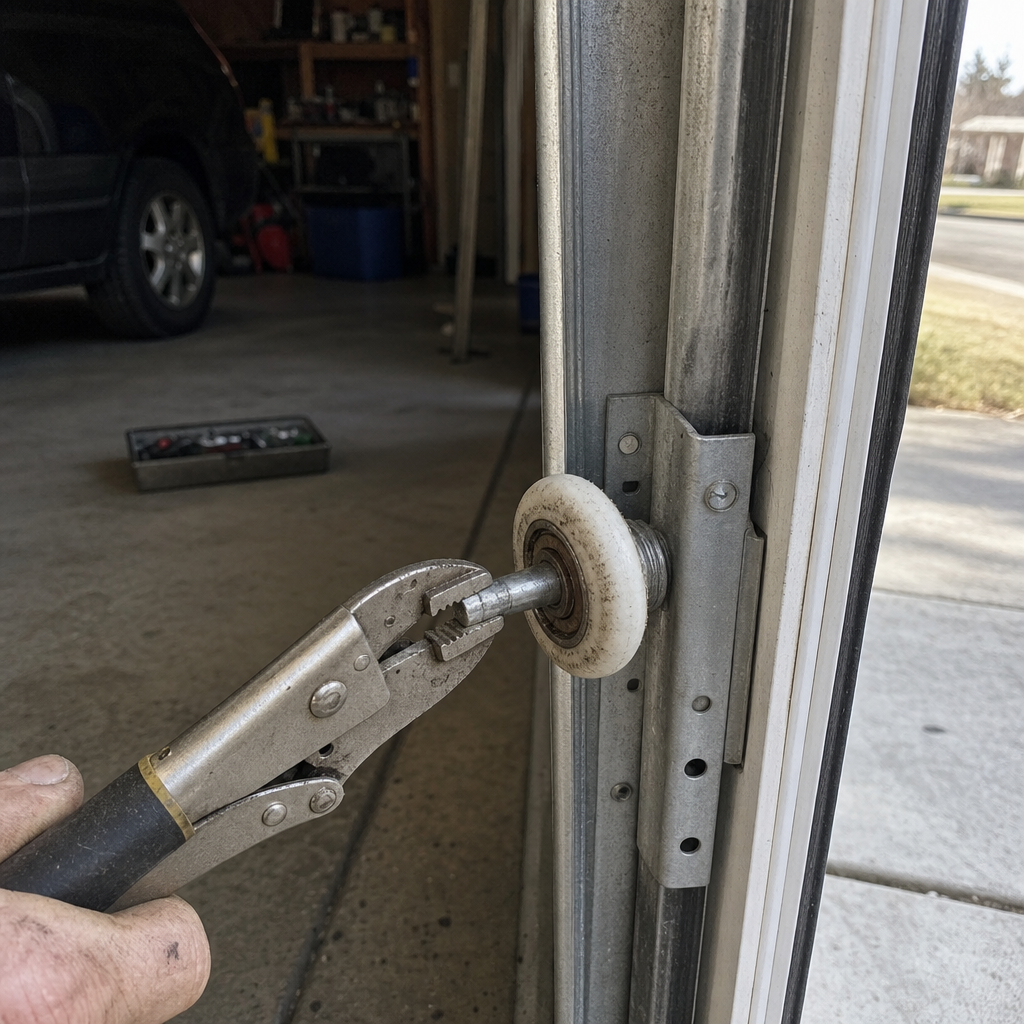
We’ve spent 17 years specializing exclusively in garage doors across Spokane, and the “reversing door” call changes character with the seasons. In July, it’s usually a spiderweb across the sensor lens or a kid’s bike handle sticking into the track. In late November, after that first hard freeze that follows our wet Octobers, the pattern shifts dramatically. That’s when we start hearing the exact same sentence: “The sensors look fine, but it still won’t close.”
Here’s the thing — in Spokane’s established neighborhoods like the South Hill and Shadle Park, where 1940s–1970s homes sit on clay-heavy soils, freeze-thaw cycling doesn’t just make potholes on your street. It literally jacks your garage slab up and down. A door that sealed perfectly in August can suddenly be hitting a raised concrete lip in December, and your opener interprets that as a child or pet in the way.
How the Down-Limit Safety System Actually Works
Most homeowners understand the photo-eye sensors — the two little boxes near the floor that shoot an invisible beam across the door opening. When that beam breaks, the door reverses. That’s straightforward, and it’s what every DIY troubleshooting guide starts with.
But the down-limit mechanism is a separate safety layer that gets almost no attention, and it’s the one that matters for the “sensors are fine, door still reverses” scenario.
Here’s how it works in plain language: your opener’s motor controller is programmed with a “close limit” — the exact position where the door should bottom out. As the motor runs, it tracks how much effort (torque) is required to move the door. If the door encounters resistance before reaching that programmed limit, the controller assumes something’s blocking the path and reverses the door. This is federally mandated safety behavior, and it’s not optional or adjustable below certain thresholds.
The critical detail: this system doesn’t know the difference between a child’s toy, a raised concrete edge, or a bottom seal frozen to the slab. It only knows “resistance before limit = reverse now.”
In our experience across Spokane, three specific conditions trigger this false-positive safety response:
- Slab heave from freeze-thaw cycling — Most common November through March, especially on the South Hill and in Shadle Park where clay soils expand and contract dramatically
- Bottom seal frozen to concrete — The first hard freeze after a wet October creates an ice bond between rubber and slab; forcing the opener burns out the motor
- Gradual down-limit drift — Over years of operation, vibration and wear cause the limit setting to shift slightly, making the system hypersensitive to any minor resistance
Two of these three are distinctly Spokane problems. You won’t find the same scale of slab heave in Seattle’s moderate marine climate, and you won’t see the same freeze-weld pattern in Portland’s milder winters.
Spokane’s Freeze-Thaw Slab Heave: The Hidden Culprit
Let’s get specific about what happens in Spokane’s garage floors.
Our continental climate delivers sub-zero cold snaps alongside 45+ inches of annual snowfall. More importantly for your garage slab, we get dramatic shoulder-season swings — overnight temperatures can drop 30–40°F, causing repeated freeze-thaw cycles in the soil beneath and around your concrete apron.
In the South Hill and Shadle Park neighborhoods, where much of Spokane’s mid-century housing stock sits, the native soil has significant clay content. Clay expands when it absorbs water, then contracts when it freezes. Over a winter season, this can raise a concrete apron by 1/4-inch or more. That doesn’t sound like much until you realize your garage door’s down-limit was calibrated to a gap measured in sixteenths of an inch.
We’ve had customers in Audubon whose doors worked perfectly through October, started reversing in mid-November, and settled back to normal operation by April — with no intervention from us except confirming the diagnosis. The slab had heaved and then settled. In those cases, recalibrating the down-limit in winter would create a dangerous gap in summer, so we advise waiting it out when the pattern is clearly seasonal.
But here’s the operator detail most competitors miss: we can distinguish slab heave from other causes by checking the myQ event log on LiftMaster and Chamberlain openers. These smart-enabled units timestamp every reversal event. If Thomas sees a cluster of reversals starting November 14th and continuing through February, with nothing in the log from June through September, that’s slab heave. If the reversals are scattered randomly across all months, we’re looking at a different mechanical issue. That diagnostic capability — reading the actual controller history rather than guessing — comes from 17 years of working exclusively on these systems.
The fix for confirmed slab heave depends on severity. Minor seasonal heave may require only patient monitoring. More pronounced or persistent heave might need down-limit recalibration after the slab settles, or in rare cases, concrete grinding or apron replacement. We don’t upsell the aggressive fix when the conservative one will do.
Bottom Seal Freeze-Weld: Same Symptom, Completely Different Fix
The second Spokane-specific winter cause looks identical to slab heave — door starts down, hits resistance, reverses — but the mechanism and solution are entirely different.
Here’s how it happens: October in Spokane is reliably wet. Rain and melting snow saturate the concrete apron and the rubber bottom seal. Then the first hard freeze arrives — typically in early to mid-November, and so predictable that experienced Spokane operators pre-stock extra bottom seal rubber and extend hours for that first frozen week. The water between seal and slab flash-freezes, creating a bond stronger than the opener’s rated pull force.
When the opener tries to close, the seal is literally welded to the concrete. The motor hits resistance, the down-limit safety triggers, and the door reverses. If the homeowner keeps hitting the button — and they always do — the motor overheats and fails.
The diagnostic distinction: a freeze-welded seal usually happens on the first operation of a cold morning, after the door has been closed overnight. The door may have closed fine the evening before. Slab heave, by contrast, causes consistent reversal every time the door approaches the floor, regardless of how long it’s been stationary.
The fix for freeze-weld is never force. We thaw the seal with controlled heat, inspect for tearing or permanent deformation from the ice bond, and replace the seal if it’s hardened or cracked. Spokane’s summer heat — those 95–105°F days on sun-exposed South Hill driveways — degrades rubber compounds faster than in milder climates, so a seal that’s already UV-damaged will tear more readily when frozen.
Prevention means keeping the apron clear of standing water before freezes, and replacing degraded seals before they become failure points. We carry replacement seal stock for all major door brands, including Clopay, Amarr, and Wayne Dalton profiles.
What You Can Check Yourself — And When to Call
We’re not interested in charging you for a five-minute fix you could handle yourself. Here’s the two-minute sensor check that rules out the most common cause:
- Locate the two photo-eye sensors, one on each side of the door track near the floor. One LED shows amber/orange, the other green.
- Check that both LEDs are steady (not blinking). A blinking amber LED means misalignment or obstruction.
- Clean both lenses with a dry cloth — spiderwebs and dust are genuine culprits.
- Verify nothing blocks the beam path: storage bins, leaf piles, snow drift.
- Test: press the wall button (not remote) to close the door. If it still reverses with steady sensor LEDs, you’ve ruled out the easy answer.
When the sensors are aligned but the door still reverses, the problem is definitively beyond DIY. The cause is mechanical — down-limit calibration, track binding, worn rollers creating drag, or the slab/seal issues we’ve described. These require specialized knowledge and tools. The down-limit adjustment in particular is safety-critical; set it too loose and the door won’t reverse on a genuine obstruction. We’ve seen homeowners create hazardous conditions trying to “fix” this themselves.
Our Garage Door Repair service covers these diagnostic and calibration scenarios. Thomas handles the assessment personally — there’s no junior tech guessing at your expense.
What Professional Diagnosis and Repair Costs in Spokane
Pricing for reversal-related issues depends on root cause and required intervention. Here’s what Spokane homeowners typically see:
| Service | Typical Range |
|---|---|
| Sensor realignment / cleaning | $120–$180 |
| Down-limit recalibration | $130–$220 |
| Bottom seal replacement | $150–$280 |
| Track realignment (if binding contributes) | $120–$240 |
| Opener repair (if motor damaged from repeated strain) | $120–$320 |
| Opener replacement (if unit failed) | $250–$550 |
Our full Garage Door Repair in Spokane service page details additional repair scenarios. For the reversal-specific issues described here, most homeowners fall in the $150–$340 range unless opener replacement is needed.
We don’t charge diagnostic fees when you proceed with recommended repair — the assessment is part of the job. And we’ll tell you straight if your door is fine and the slab just needs time to settle. “Tell me what it’s doing, and I’ll tell you what it needs.” That’s how we’ve operated for 17 years.
Key Takeaways
- Steady sensor LEDs with continued reversal means the problem is mechanical — likely down-limit calibration, slab heave, or seal freeze-weld
- Spokane’s freeze-thaw climate makes slab heave and bottom seal freeze-weld genuine seasonal culprits you won’t find in milder markets
- LiftMaster and Chamberlain myQ openers log reversal events — this diagnostic history distinguishes seasonal patterns from random failures
- Never force a door that’s meeting resistance; motor replacement costs far more than the correct fix
- Sensor alignment is DIY-checkable; down-limit adjustment and mechanical diagnosis require professional calibration for safety
FAQs
The opener’s down-limit safety system detects resistance before the door reaches its programmed close position, which triggers automatic reversal — this can happen from slab heave, a frozen bottom seal, or internal mechanical binding even with clear sensors. In Spokane’s climate, we see this most often in late fall and winter when freeze-thaw cycles raise concrete aprons or ice-weld seals to the floor. Call (844) 656-2094 for an exact diagnosis — estimates are free.
Most reversal-related repairs in Spokane run $150–$340, with simple recalibrations at the lower end and bottom seal replacement or opener component repair toward the middle. Full opener replacement if the motor has failed from repeated strain ranges $250–$550. We don’t charge separate diagnostic fees when you proceed with repair. Call (844) 656-2094 for a specific quote — estimates are free.
You can and should check sensor alignment and lens cleanliness — look for steady (not blinking) amber and green LEDs — but if sensors are aligned and the door still reverses, the cause is mechanical and requires professional tools and safety knowledge. Incorrect down-limit adjustment can create a crushing hazard. When sensors check out but reversal continues, call a technician. Call (844) 656-2094 and Thomas will walk through what he’s seeing before scheduling.
Seasonal-only reversal in Spokane almost always points to freeze-thaw slab heave or bottom seal freeze-weld — both caused by our continental climate’s dramatic temperature swings and clay-heavy soils. The door may close fine in summer because the slab hasn’t heaved and the seal isn’t frozen. A myQ-enabled LiftMaster or Chamberlain opener’s event log can confirm this pattern with timestamped reversal data. Call (844) 656-2094 for seasonal-specific diagnosis — estimates are free.
If you’d rather have it looked at, Titan Garage Door Service Greater Spokane offers a no-pressure assessment in Spokane — call (844) 656-2094.
Written by Thomas Hernandez, Owner & Lead Technician at Titan Garage Door Service Greater Spokane, serving Spokane, WA.